February 26, 2014

Poème pour Tali

Allez ma petite Tali chérie,
Il faut téter !
Il faut téter,
Et il faut m'aimer.
Il faut téter,
Il fait m'aimer,
Il faut pépé Popi
Il faut papa Jojo
Il faut papy Bertie
Il faut maman Olélie,
Il faut mamie F et mamie Grecque.
Il faut dodo.
Surtout dodo !
Bonne nuit ma petite chérie

February 22, 2014

Manifeste d'un jeune père

(An English version follows here.)

Ma fille chérie, nous nous engageons, ta mère et moi, à faire toujours tout notre possible pour :
- Placer tes besoins avant les nôtres
- Respecter ta nature comme on respecte un paysage pristin
- T'équiper des outils nécessaires à la vie : confiance en toi, maîtrise de toi, persévérance, souplesse d'esprit, humour, joie de vivre, empathie, introspection, résilience
- T'enseigner à faire confiance, à être indépendante mais aussi à être dépendante, savoir aimer et savoir être aimée,
- Te donner des connaissances et t'apprendre à apprendre,
- T'écouter et être à ton écoute
- T'encourager dans ce que tu entreprendras, et dans les voies que tu choisiras, même lorsque nous ne les comprendrons pas,
- Respecter tes choix même s'il s'agira de nous tourner le dos,
- T'aimer de tout notre cœur et de toute notre âme,
- Te protéger et à t'apprendre à te défendre,
- Satisfaire tes besoins sans t'utiliser pour satisfaire les nôtres

August 24, 2013

Wind rose of Jerusalem

Where does the wind blow from in Jerusalem? I was wondering because I needed to know how to get fresh air in the evenings into our (future) apartment.

I couldn't find the information, so I pulled two years' worth of meteorological data (2011 & 2012) for Jerusalem from http://data.gov.il/ims and set about to create a graphic view of the wind direction, weighted by its speed, in Excel. Here's the result:


Unquestionably, the dominant direction is from the West (West-North-West to be accurate), and especially so in the summer!

There's more to it as one could not weight by wind speed (taking into account values only above a given threshold), or on the contrary weight by something more meaningful, e.g. wind energy - but I'm not interested in putting up a wind turbine at this stage! - but I'll post more on this later if prompted.

June 07, 2013

For old times' sake

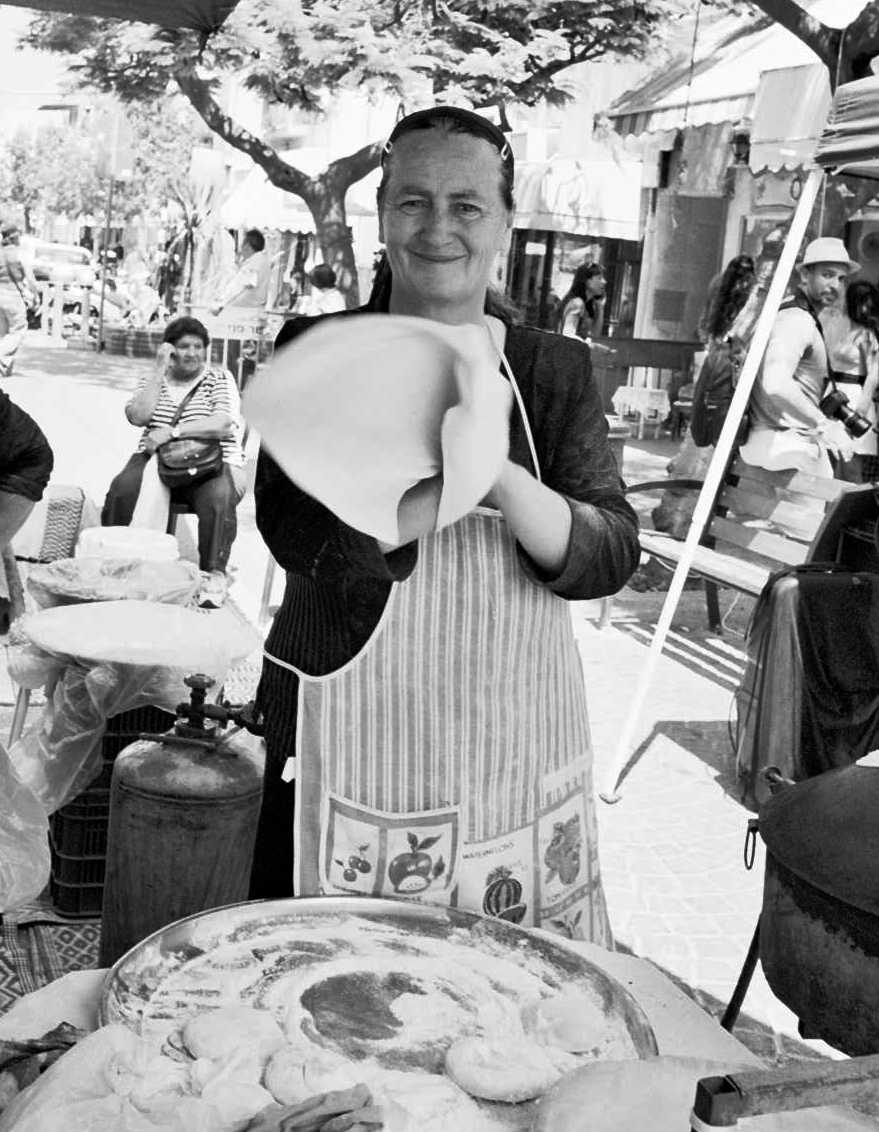
About three weeks ago, my wife and I joined a group of French speakers on a "photographic tour" of the Nahalat Binyamin neighborhood in Tel Aviv. 

On Fridays, the Nahalat Binyamin street is crowded by stalls of artists and craftsmen and craftswomen and by jugglers and musicians - as well as the sheshbesh players, elderly dwellers of the neighborhood.

On this occasion, I pulled my M6 Leica from its shelf, my wife went out of her way to buy the Kodak BW400CN film I'm used to and I experienced anew the smell of the film, the meticulous activity of loading of the film, the thought invested in each picture, conscious of its cost and its potential value, the manual focus with the telemeter, the measuring of the light and after that the feeling and hope that there are - literally - latent images, potential masterpieces, in that undeveloped film. The pictures could be good, one or two could be excellent, some will be missed, most will be disappointingly mediocre. This experience was worth the effort. It took me back in time to Cambodia, to Paris, to my first years in Israel, when I would regularly walk with my film camera in search of the photographic experience that Patrice Moracchini ingrained in me.

What a smile!

 Nitzan Gilad, ceramic artist

 René Borda, probably the only Bolivian Indian living in Israel... 

Aliya from Dalyat al-Carmel, preparing a Druze pita 

 Oh weren't they angry at me for taking a picture of them while they played! But I didn't want to interrupt them...


November 28, 2012

Homage


Years ago, a friend acquainted me with the famous poem by William Wordsworth from which the uncanny quote comes, "The Child is father of the Man". 

Often, I'm reminded of this quote  and of the friend.

I stumbled today upon an article in the New York Times which used the quote as title, with a twist: The Father Is Child of the Man, by Bruce Feiler.

The author quotes Mary Catherine Bateson, an anthropologist, as saying:
“A great amount of what parents learn we are taught by our children.”

I wished it were true. It should.

"MY HEART LEAPS UP WHEN I BEHOLD"

          My heart leaps up when I behold
              A rainbow in the sky:
          So was it when my life began;
          So is it now I am a man;
          So be it when I shall grow old,
              Or let me die!
          The Child is father of the Man;
              I could wish my days to be
          Bound each to each by natural piety.


Yet another satirical map

After the initial survey (http://what-s-next.blogspot.co.il/2007/11/world-according-to-americans.html) and the more recent addition (http://what-s-next.blogspot.co.il/2010/11/world-according-to-americans-redux.html), a friend at work suggested yet another satirical map, actually a parody of the seminal New Yorker cover: the Apple Maps' view of the World! :-)


MAD Magazine NewYorker View 2012

September 23, 2012

In ages...

Dear Readers,

I haven't written in ages... And yet so much has happened in my life! For starters, I've gotten married :-) So now it's two of us that make one.

Another thing I haven't done in ages: write a program, think of algorithms, use Scilab. I did all these three in the past week, after playing with this new popular toy called NeoCube / Buckyballs / Nanodots: they're really hard to put down and indeed they raise interesting questions of stable conformations in space.

In which directions are the poles of each ball aligned? That's what I want to know!

I looked up the magnetic field of a dipole, the potential energy of a dipole in a magnetic field and thought of how to implement the computation of stable conformations.
My script found the orientation of the poles in this 2D configuration...

For a start, I installed Scilab, which I hadn't used in years, and despite annoying bugs and crashes (version 5.3.3 wouldn't run on my Mac, I'm running 5.4.0-beta3) here are three results I eventually obtained that gave me comfort: I'm not entirely rusty yet and can still program something simple.

The next stages would be the have proper algorithms to compute stable conformations in 3D and I know that that is a difficult problem (e.g. protein folding...)


... and in this one (which I hadn't guessed)
And here, I'm sorry you can barely see the plot but it was really the first quantitative result of the algorithm that I couldn't have predicted with simple logic: at which angle exactly are the poles at the two bounds of this chain?