November 02, 2007

Concert: Ehud Banai & Mashina


Ehud Banai and Mashina in a joint performance in Caesarea, last Thursday.

The performance starts with a song inspired by a Sabbath zemirah:


The amphitheater is packed:


Lighting and tones change, everyone runs in all directions...


And no one will let them go when they finish...

The World according to Americans

"The World according to Ronald Reagan", by Pulitzer Prize-winning cartoonist David Horsey (click to zoom):


(source: http://www.csc.calpoly.edu/~bfriesen/images/reaganposter.jpg)

It dates from 1982+ because the Falklands War and the occupation of Beirut by Israel happened in 1982. This original which was plagiarized to give the following variation:


(source: http://strangemaps.files.wordpress.com/2006/11/800px-reagan-digitised-poster.JPG)

A less artistic but still funny one is "The World according to America" whose author claims he didn't know Horsey's cartoon (see the legend and the 2003 version):


(source (broken): http://www.jigsawlounge.co.uk/kungfu/world/america.gif)

And more recently, people tried to picture how George W. Bush saw the World in "The World according to Dubya":


(source: http://strangemaps.files.wordpress.com/2006/12/298202156_73e54012fa_b.jpg)

October 30, 2007

Luz II in the news

Luz II latest steps are described in Globes online...

October 18, 2007

Jordan, impressions

Am I back on the blog? I hope so. Let me try to add some impressions about Jordan that I didn't have time to write in the first post.

Overall it was a great experience: it felt wonderful to be in the desert, sleep the first night under a beautifully clear sky, see the remnants of a hard-to-grasp past (this I discussed in my first post), drink excellent tea prepared by bedouins, (try to) smoke the narghile, etc...

Part of the experience was also reading some English-language Jordanian magazines in the hotel in Petra, mostly one focusing on society called "OK". I noticed the reform of education was a big subject. Many other modernization projects were mentioned. Also, the Jordanian "blogosphere" was mentioned with a page on a Jordanian blogger who had made his "coming out" on his blog: the magazine reported reactions from other bloggers and from the doctor responsible for the AIDS program in Jordan - if I'm not mistaken. Most reactions were critical, saying, for the most moderate, that his sexual life did not interest them and for the more conservative that it was a shame.

Last impression. I bless the benefits of peace, allowing to travel freely from the Jewish, westernized, Israel to its traditional, Arabic neighbor across the Jordan. Similar landscapes but a different world, only a quick border crossing away. If only the same could be achieved with the West Bank...

I'm presently learning Arabic but can only say a few words so far, so I'm eager to learn more and return to try my Arabic in Jordan!

Surprise!

My photographic creativity has now no limits and my journalistic talents will not be impeded anymore, hot news will arrive on your screens with pictures within minutes of their happening! In other words, I got my Canon G9!


Me

My office

And my boss!

October 06, 2007

Jordan, a neighbor

I took the opportunity of the Sukkot holiday to visit Jordan for a couple of days and relax for an additional day in Eilat.

My plan was initially to visit on my own but it turned out it was simpler to book an organized tour for my first visit. The tour, with an Israeli company called Desert Eco Tours went thus:
  • Sunday evening: entered Jordan at Aqaba crossing, were taken to a camping site in the Wadi Rum region for the night.
  • Monday: Jeep tour in the Wadi Rum nature reserve. Dunes, mountains, inscriptions on the rocks.
  • Tuesday: guided tour of Petra. Nabatean necropolis, Roman cardo and temples, Byzantine church.
  • Wednesday: from Petra down to the Arava valley and back to the Aqaba crossing.
The trip was at once a welcome distraction from work and the atmosphere in Jerusalem, a chance to learn some history and the uncommon experience of visiting an Arab country with a group of easily identifiable Israelis.

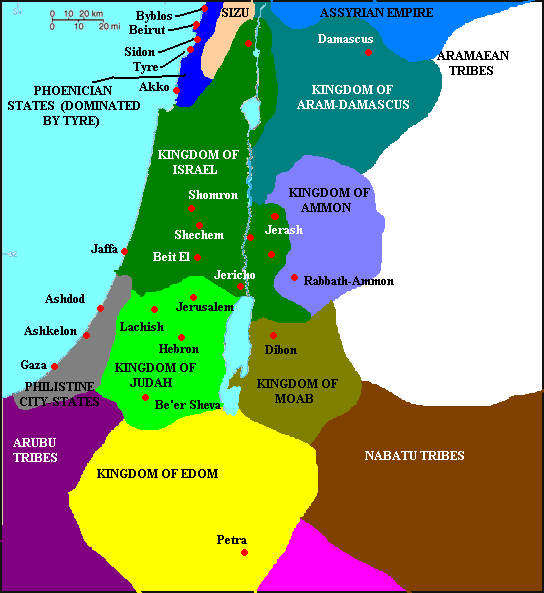
History. Trying to grasp the ancient routes (King's Highway, Incense Route), remember the map and chronology of local peoples (Nabateans, Edomites, Moabites, Ammonites, Israelites, ...) and the history of the conquests (Assyrians, Babylonians, Persians, Greeks, Romans, Arabs, Crusaders, ...) is not a piece of cake!

I find it particularly challenging to understand the early Biblical period because the narrative of the Bible is often given as the starting hypotheses with historical speculations and observations coming next. For example, the Wikipedia article on Edom starts:

Edom (Hebrew: אֱדוֹם, Standard Edom Tiberian ʾĔḏôm ; "red") is a name given to Esau in the Hebrew Bible, as well as to the nation descending from him. The nation's name in Assyrian was Udumi; in Syriac, ܐܕܘܡ; in Greek, Ἰδουμαία (Idoumaía); in Latin, Idumæa or Idumea.
I find it very confusing to start defining something real by the Biblical myth usually associated with it! The next paragraph explains:
The Edomite people were a Semitic-speaking tribal group inhabiting the Negev Desert and the Arabah valley of what is now southern Israel and adjacent Jordan. The region has much reddish sandstone, which may have given rise to the name "Edom". The nation of Edom is known to have existed back to the 8th or 9th century BCE, and the Bible dates it back several centuries further. Recent archeological evidence may indicate an Edomite nation as long ago as the 11th century BCE, but the topic is controversial. The nation ceased to exist with the Jewish-Roman Wars.
This explanation is better, stating facts and then referring to the Bible for comparison, but if you pay attention, in a single sentence you go from something which "is known" (meaning proven by inscriptions?) to "the Bible" and back to "archeological evidence", so one has to keep in mind three different versions of the same fact.

It turns out, if I understand well, that the travel of the Israelites from Mount Sinai to Mount Nebo according to the Pentateuch makes historical sense, which is a surprise to me...

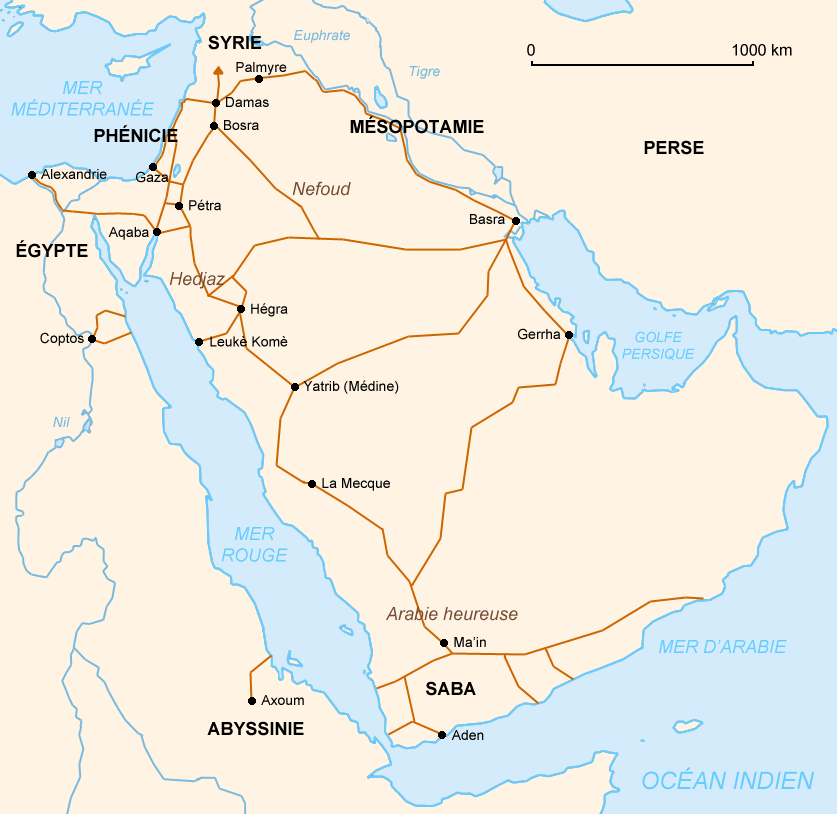
In red on this map the King's Highway:


The main Nabatean roads... I don't know how much the map can be trusted but we were told over and over about the Incense Route which should run from the South of the Arabian Peninsula to Gaza through Wadi Rum and Petra.

Map of the Levant, c. 830 BCE.


I'll write more about what I thought about Jordan soon, let me publish this already.

September 28, 2007

What will become of this blog?

Where did it come from?

My first blog was called "Joseph in Cambodia", and basically that was the story: Joseph's trip there. Even though I was working, I was basically a tourist visiting a foreign country.

The present blog which you're reading received the name "What's Next" when I knew that my next destination would be Israel but I didn't want to disclose it yet (as my parents didn't know my plans).

But it turns out that there is an other good reason for not having a kind of "Joseph in Israel" title. Here, there is much more to the story than a trip. I'm not a tourist here, it turns out I have really moved here, however smoothly I went from the status of "Tourist" to that of "Working Tourist" and from there to "Temporary Resident".

In a way, this explains why there's less to tell in this blog than I expected: I'm not reacting to things on a per-event basis and the important evolutions and choices are so personal that I hesitate to write about them on this public space.

How will I manage to write about them in the form of a public blog? Let me try my hand at this exercise of writing such a personal story while keeping some privacy.

Learning how to become an Israeli

The Zionist ideology required in the past from immigrants to all but forget their original culture (including their mother tongue! - see Nurit Aviv's Misafa Lesafa). Since I knew that this had been relegated as a thing of the past, I thought that one could immigrate today without having to force onto oneself any change of culture. That was a mistake. Although on more subtle level, I still need to learn how to become an Israeli. To be impolite and aggressive is an important part of it: if I am too polite or too gentle, I will not be considered a real Israeli. I was explained that politeness is not just an free bonus of life in society and that it actually places a distance between people which doesn't exist in the Israeli society. For the better of for the worse, I can't keep French politeness and be an Israeli. If I'm too gentle, I won't get consideration either, aggressiveness is an essential part of life here.

From the religious point of view there are also important things which took me months to understand. I'll write about this soon (בלי נדר, bli neder of course!).

From an ideological point of view, it is very subtle. I realize how the point of view of the mainstream Israeli society gets inside me slowly. It's in everything: the news and media obviously, the way people refer to the "rest of the world" (in Hebrew, one syllable: חו"ל, chul), where and how people travel : if you live here, you're immersed into an ideology and slowly forget how most of the rest of the world, this famous chul, thinks about Israel. I realize that I get influenced against my will. Is my mind more easily influenced than an other's? Lacking definite opinions? I just can't help my primary source of information be the that the broadcasts of the Israeli radios (Kol Israel and Galei Tsahal).

Temporary conclusion

Two things are happening at the same time.

First, the one which obsesses me. I chose to face the challenge of being happy in a sedentary life: a desk-bound job, an apartment and living in a place where I have good reason to be involved in political and social issues. My life here is much less of a "carpe diem" than in Cambodia and I can't explain exactly why.

The second thing, is that "integration" is something much broader than I expected. It is about finding a compromise between adopting a society's ideology, way of life, codes and one's own values, habits and freedom.

My intuition is that the explanation to the first problem is in the second: belonging somewhere is the hardest challenge I could face, because I was raised to be always independent of the society I lived in. It is a radical change for me. I consciously chose to face it when I left Cambodia, but it's not easy.

I treat my anxiety with regard to both problems by setting milestones on my way to integration, as well as having other projects like learning Arabic, writing this blog or photography.

Underneath this idea to integrate is a wish for my children, if I have some one day, to grow up in a society to which they belong.